Is AI-Plus-Human Inbound Sales Support a Fit for Your Team?
How B2B revenue leaders evaluate inbound channel coverage, human qualification context, and conversation-versus-appointment paths before choosing an AI-plus-human sales service.
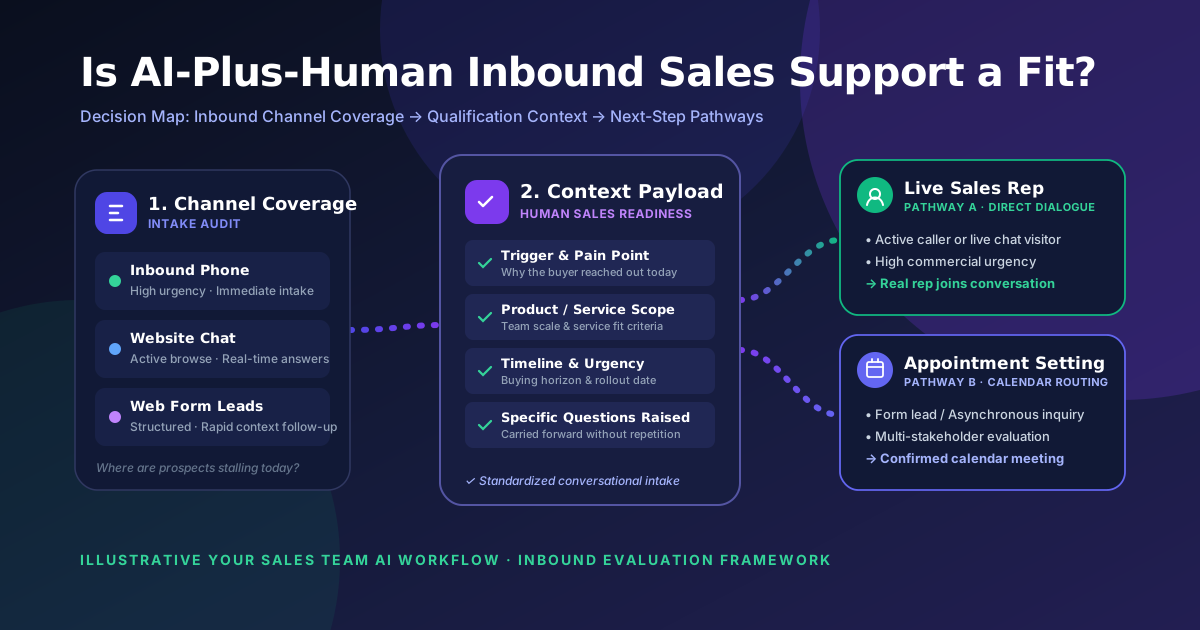
When prospective buyers reach out to a B2B company, they are already experiencing an active business problem. Whether they call an inbound phone line, type a message into a website chat box, or fill out a high-intent contact form, their interest is highest at the moment of outreach.
For revenue leaders, responding to that inbound interest presents a persistent operational dilemma.
Relying entirely on an unstaffed, standalone software tool or rigid automated chatbot often frustrates high-value prospects, who get trapped in unhelpful loops and abandon the interaction. Conversely, staffing an around-the-clock internal team of Business Development Representatives (BDRs) or Sales Development Representatives (SDRs) involves substantial payroll overhead, recruitment lag, and management strain—especially when inquiry volume fluctuates unpredictably across channels.
An AI-augmented inbound sales service offers a third approach: combining automated speed for immediate first response and intake qualification with real human sales representatives who join the conversation to build rapport, navigate complex nuances, and guide buyers into booked sales.
However, an AI-plus-human model is not an identical fit for every B2B sales motion. Evaluating whether this service fits your revenue organization requires answering three foundational questions:
- Which inbound channels actually need immediate coverage?
- What specific qualification context do human sales reps need before engaging?
- Where does your sales motion require a live sales conversation versus a scheduled appointment?
This guide provides an operational framework to help revenue leaders evaluate these questions and determine organizational fit.
1. Determine which inbound channels need active coverage
B2B revenue organizations rarely receive inbound demand through a single isolated touchpoint. Buyers reach out across different mediums depending on urgency, company culture, and where they encounter your company.
Evaluating service fit starts with auditing where inbound prospects currently stall, drop off, or wait too long for a meaningful response.
[ Inbound Inquiries ]
       │
       ├─────────────────────┬─────────────────────┐
       ▼                     ▼                     ▼
[ Phone Calls ]       [ Website Chat ]     [ Form Submissions ]
- High urgency        - Real-time browse   - Structured research
- Needs immediate     - Needs concise      - Needs rapid
  qualification         answers              context-rich follow-up
Inbound phone inquiries
Phone calls represent the highest immediate intent in B2B sales. A prospect calling your sales line is actively setting aside time in their day to speak with someone. When a phone call goes to an unattended voicemail box, the prospect frequently moves straight to a competitor.
- Fit indicator: Your business receives inbound sales calls that go unanswered during peak hours, lunch breaks, or after standard business hours, leading to lost pipeline.
- Evaluation question: Do callers need immediate answers to preliminary capability questions and structured qualification before being connected to a human representative?
Website chat interactions
Visitors engaging with website chat are often in active evaluation mode—comparing solutions, reviewing pricing models, or checking specific feature requirements. A delayed chat reply causes visitors to bounce within minutes.
- Fit indicator: Your website generates steady commercial traffic, but chat conversations either go unanswered or rely on rigid menu bots that fail to collect meaningful buyer context.
- Evaluation question: Can an automated conversational layer greet the visitor, address foundational scope questions, and immediately transition the thread to a human sales rep or scheduling path?
Inbound web form submissions
Contact forms, demo requests, and quote inquiries are standard inbound drivers. However, traditional form handling often routes submissions into an email inbox or CRM queue where they sit for hours or days before manual follow-up occurs.
- Fit indicator: Your team generates form submissions, but response times lag, and prospects have cooled off or forgotten their specific question by the time an SDR reaches out.
- Evaluation question: Would your conversion path benefit from an immediate automated response that confirms receipt, captures qualifying details, and offers an immediate next step while intent is fresh?
If your inbound volume is heavily concentrated in one or more of these channels and your existing reps struggle to maintain rapid, consistent initial contact, an AI-augmented service provides the responsive infrastructure required to capture that interest.
2. Identify the qualification context human reps actually need
A frequent failure mode in automated sales tech is treating qualification as an obstacle course: bombarding the buyer with twenty rigid questions before allowing them to speak to a person. Conversely, simply passing a name and phone number to a sales rep forces the buyer to repeat everything they just explained.
As detailed in our guide on how qualification should prepare the sales conversation, effective qualification is not an interrogation. It is the structured context payload that allows a human sales representative to begin the next conversation with momentum, empathy, and relevance.
When evaluating whether an AI-plus-human service fits your motion, examine what information your account executives or sales reps actually require before they can hold an effective commercial discussion:
The Essential Context Payload
| Qualification Dimension | What the Human Rep Needs to Know | What the First Response Captures |
|---|---|---|
| Trigger & Core Problem | What specific challenge prompted the buyer to reach out today? | The buyer’s stated operational pain point or business objective. |
| Product or Service Fit | Which offering, tier, or solution line matches their scope? | Stated service area, scale requirements, or operational constraints. |
| Buying Stage & Urgency | Is the buyer actively researching for an immediate rollout or gathering long-term ideas? | Target implementation timeline and whether a current contract is expiring. |
| Specific Buyer Inquiries | What specific questions did the buyer raise during intake? | Unresolved questions regarding capabilities, pricing models, or implementation. |
| Decision Authority & Scope | Who else is involved in the evaluation? | Organizational role, team size, and evaluation stakeholders. |
Assessing organizational fit for context collection
An AI-plus-human service fits your team if your qualification criteria can be standardized into clear, conversational prompts that a system can capture naturally across phone, chat, or form.
- High Fit: Your sales team has 3 to 5 clear criteria (e.g., business size, service requirement, timeframe, current solution) that determine whether an opportunity is qualified. The initial response gathers these answers so the human sales rep enters the conversation prepared.
- Low Fit: Your sales qualification requires an immediate, non-standard technical diagnostic, live code review, or complex custom architectural calculation that cannot be scoped through conversational intake questions.
When the intake layer gathers the right context, the human rep does not waste the first ten minutes asking basic administrative questions. They greet the buyer acknowledging their stated need: “I see you’re evaluating inbound response for a 15-person team looking to cover phone and chat before next quarter. Let’s talk through how that workflow looks.”
3. Map human conversations versus appointment-setting paths
A common misconception among revenue leaders is that every qualified inbound lead should immediately be routed to a live phone transfer. In practice, forcing an immediate transfer when the buyer is sitting in an airport terminal or between internal meetings creates friction.
A mature inbound sales motion recognizes that qualified interest belongs in one of two complementary pathways:
[ Qualified Inbound Inquiry ]
              │
              ├─────────────────────────────────────────┐
              ▼                                         ▼
   [ Pathway A: Live Conversation ]          [ Pathway B: Appointment Setting ]
   - Buyer is live on phone/chat             - Buyer has limited immediate time
   - Urgent operational requirement          - Multi-stakeholder review needed
   - Immediate commercial discussion         - Scheduled calendar consultation
Pathway A: When a live human sales conversation belongs
A direct, immediate conversation with a human sales representative is optimal when:
- The buyer is live on the phone or active in chat: They have expressed immediate availability and want to explore their business needs right now.
- High commercial value or time sensitivity: The buyer has an urgent deadline, an active service outage, or a high-priority purchase cycle where immediate engagement prevents them from calling a competitor.
- Consultative nuance required: The buyer’s questions involve strategic trade-offs or complex operational variables that require human judgment and rapport.
Pathway B: When appointment setting is the right next step
Scheduling a dedicated appointment or calendar consultation is the superior path when:
- Asynchronous or form intake: The buyer submitted a contact form from their desk while multitasking and prefers a scheduled meeting slot on their calendar.
- Multi-stakeholder evaluations: The evaluation involves a cross-functional buying committee (e.g., revenue operations, sales leadership, procurement) who need an agreed calendar invitation.
- Preparation required: A tailored demonstration, platform walkthrough, or custom proposal requires the sales team to review the captured qualification payload before meeting.
- After-hours or off-peak inquiries: The inquiry arrives outside standard business hours, making an immediate scheduled appointment the cleanest path to lock in mutual commitment.
An AI-augmented sales service provides the operational agility to execute both pathways: maintaining real human sales reps who can step into live conversations when appropriate, while seamlessly routing other qualified inquiries into confirmed appointment-setting paths.
4. Blank buyer-fit evaluation worksheet
Use this self-administered evaluation worksheet to assess whether an AI-plus-human inbound sales service aligns with your current sales motion. Review each section with your sales and revenue operations leadership.
================================================================================
YOUR SALES TEAM AI — INBOUND SALES SERVICE BUYER-FIT EVALUATION WORKSHEET
================================================================================

PART 1: INBOUND CHANNEL AUDIT
--------------------------------------------------------------------------------
1. Current inbound inquiry volume across channels:
   [ ] Inbound Phone:  Approx. ________ calls/week   (Est. % missed/unanswered: ____%)
   [ ] Website Chat:   Approx. ________ chats/week   (Est. % abandoned: ____%)
   [ ] Web Forms:      Approx. ________ forms/week   (Average response time: ____ hours)

2. Channel friction audit:
   - Where are prospective buyers experiencing the longest response lag?
     ___________________________________________________________________________
   - Do inquiries arriving after business hours receive a helpful first response?
     [ ] Yes   [ ] No   [ ] Only automated generic email auto-responder

PART 2: FIRST-RESPONSE & STAFFING CAPACITY
--------------------------------------------------------------------------------
3. Current internal sales-rep allocation:
   - How much time do your senior sales reps spend on initial intake & basic qualification?
     [ ] Minimal (< 10%)   [ ] Moderate (10–30%)   [ ] Significant (> 30%)
   - Is building, recruiting, and managing an internal 24/7 BDR team cost-effective?
     [ ] Yes, we have dedicated headcount   [ ] No, it creates prohibitive overhead

4. Response speed requirements:
   - Does your market reward immediate initial response across phone, chat, and forms?
     [ ] Yes, buyers actively evaluate multiple competitors simultaneously
     [ ] No, our buyers exclusively expect delayed formal RFPs

PART 3: QUALIFICATION PAYLOAD DEFINITION
--------------------------------------------------------------------------------
5. Identify your 3 to 5 non-negotiable qualification criteria:
   Criteria 1: _________________________________________________________________
   Criteria 2: _________________________________________________________________
   Criteria 3: _________________________________________________________________
   Criteria 4: _________________________________________________________________
   Criteria 5: _________________________________________________________________

6. Can these criteria be collected conversationally during an initial response?
   [ ] Yes, they are straightforward operational questions
   [ ] No, they require confidential deep-dive technical audits

PART 4: NEXT-STEP ROUTING ARCHITECTURE
--------------------------------------------------------------------------------
7. Define your target next-step split:
   - What percentage of qualified inquiries should route to an immediate live human rep?
     Estimated Target: ________%
   - What percentage of qualified inquiries should route to scheduled appointment setting?
     Estimated Target: ________%

8. Decision outcome:
   [ ] HIGH FIT: Multiple channels need coverage, qualification can be standardized,
       and our team needs human sales reps involved without hiring a full in-house team.
   [ ] EXPLORING: Need to align internal stakeholders on qualification criteria first.
   [ ] LOW FIT: Low inbound volume, single-channel phone only, or pure self-serve software.
================================================================================
5. Illustrative scenario: Evaluating an inbound sales transition
To see how a B2B organization applies these evaluation criteria in practice, consider the following hypothetical evaluation scenario.
The Company: ApexField Software is a mid-market B2B software provider offering field operations management software to commercial contracting firms.
The Operational Bottleneck: ApexField was investing heavily in digital demand generation, generating approximately 90 inbound inquiries per week split across website demo forms, inbound sales calls, and website chat. However, their sales motion suffered from three distinct friction points:
- Channel Disconnection: Inbound phone calls often went to voicemail during team meetings, while chat conversations were managed by a basic keyword widget that provided canned links rather than conversational intake.
- Context Loss: When an account executive contacted a form submitter two days later, the buyer frequently complained: “I already explained my fleet size and dispatch issues in the form note.”
- Staffing Overhead: Leadership considered hiring three full-time junior SDRs to monitor phone lines and chat, but projected hiring costs, onboarding delays, and management overhead made that option financially unattractive.
The Buyer-Fit Evaluation: ApexField’s VP of Revenue conducted an evaluation using the four-part framework:
- Channel Coverage: They identified that phone and chat required immediate interactive handling, while demo form submissions needed an instant, structured follow-up.
- Qualification Context: They established four essential context points: number of dispatch technicians, current scheduling software, target deployment quarter, and primary operational frustration.
- Routing Pathways: They determined that callers with immediate buying urgency should be connected to a live sales representative, while demo form inquiries and after-hours chat visitors should be routed into a calendar appointment-setting path.
The Implementation Outcome: Instead of funding an expensive internal SDR desk, ApexField partnered with an AI-augmented inbound sales service. The AI layer provided instant conversational intake and structured qualification across phone, chat, and forms. Real human sales representatives joined active conversations when buyers were ready to engage, and guided qualified leads directly into scheduled demonstrations on account executive calendars.
(This scenario is a strictly illustrative example designed to demonstrate workflow planning; it does not represent an actual client endorsement, specific integration, or guaranteed conversion rate.)
6. How Your Sales Team AI supports your inbound sales motion
When your evaluation indicates that an AI-augmented service fits your sales motion, Your Sales Team AI provides the done-for-you operational foundation to put it into action.
Rather than offering an unstaffed software widget or leaving your team to configure complex automation trees alone, Your Sales Team AI acts as an extension of your sales operation:
- Comprehensive Inbound Coverage: Responds to inbound calls, chats, and form submissions with an approved, brand-aligned starting conversation.
- Structured Qualification: Gathers the precise context your sales process requires before advancing the lead.
- Real Human Sales Representatives: Integrates experienced human sales professionals into the sales conversation and appointment-setting paths, ensuring your pipeline benefits from personal rapport and commercial accountability.
- Appointment Setting & Next Steps: Converts inbound interest into confirmed calendar meetings or qualified sales conversations.
Commercial terms and subscription details
For organizations seeking phone-based inbound response and qualification, Your Sales Team AI offers straightforward, transparent commercial terms:
- AI Phone Agent Base Subscription: $249 per month, month-to-month agreement.
- Zero Setup Fee: $0 setup or onboarding fee.
- Included Monthly Allowance: 500 inbound voice minutes and 500 SMS text messages per monthly billing period.
- Predictable Usage Rates: Additional voice usage is billed at $0.15 per minute; additional text messaging is billed at $0.03 per SMS.
- Sales-Assisted Initial Setup: A sales agent assists with establishing your initial call flow and qualification logic. Subsequent modifications can be made directly in the platform, with customer support available for ongoing assistance.
- Flexible Renewal Policy: Cancel prior to the end of the current billing period to prevent renewal. Service remains active through the paid period, and any incurred overages remain due. Prepaid monthly service refunds are evaluated case by case. Full details are governed by our Terms of Service.
7. Next steps for B2B revenue leaders
Determining whether an AI-plus-human inbound sales service fits your team comes down to aligning automated responsiveness with human selling expertise. By mapping your inbound channels, standardizing your qualification payload, and defining clear conversation-versus-appointment pathways, you can ensure that every inbound prospect receives a prompt, professional, and productive sales experience.
- Explore our operational workflow: Read How Your Sales Team AI Works to examine the four-step path from first response to sales next step.
- Review common questions: Visit our FAQ for detailed answers on channel handling, qualification logic, and human sales rep involvement.
- Examine cross-channel continuity: Learn how to unify your phone, chat, and form intake in Phone, chat, and form leads need one clear next step.
- Understand the handoff transition: Read Where the AI response ends and a human sales rep begins and Qualification should prepare the sales conversation.
- Map your inbound motion: Book a call with our team to discuss your channels, qualification criteria, and sales next steps, or start standard phone service directly.