Write a first-response question that starts a useful sales conversation
Start with the reason for the inquiry, then earn the right to ask more.
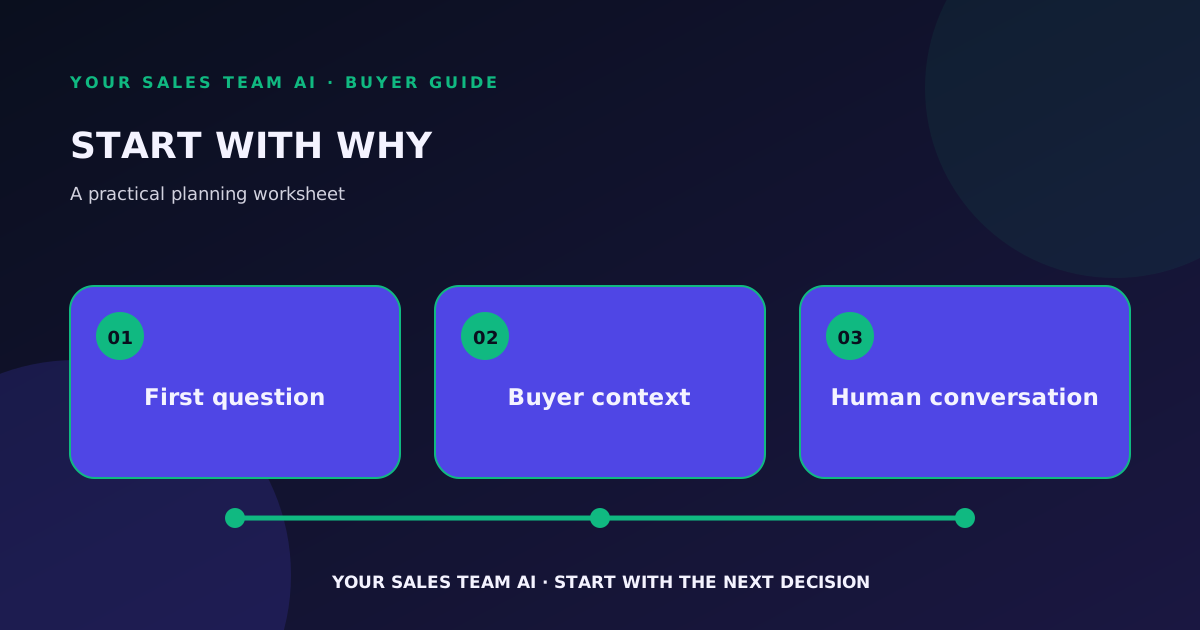
A useful first question asks why the buyer reached out now in words they can answer. It should leave room for their own explanation and give the next sales person enough context to continue, without claiming the prospect is qualified or ready to book. This is a buyer-side writing exercise, not a script or response-time promise for the service.
Make the opening easy to answer
Compare “What is your annual budget, implementation date, and decision authority?” with “What prompted you to reach out?” The first may be useful later in some sales processes, but it asks for three different decisions at once. The second invites the prospect's reason, which a person can explore. Your team may need a more specific opening; choose one that fits the actual inquiry channel and your sales motion.
Illustrative: A buyer submits a form saying, “We need help responding to inquiries.” An opening question might be, “Which inbound inquiries are hardest for your team to follow up on?” It should not imply that Your Sales Team AI has already reviewed the buyer's systems or can guarantee a booked meeting.
| First question candidate | What a buyer can answer | What a rep still needs to learn |
|---|---|---|
| Your proposed wording | One clear reason or situation | Fit, urgency, buying process, and next step as appropriate |
Test the handoff, not just the wording
Ask a colleague to respond as a prospect with little context. Can they answer in one or two sentences? Would a human representative know what to ask next, or did the question only produce a vague label? The qualification guide explains what context should move forward; the rep-boundary guide keeps human judgment visible.
Do not treat the first response as a substitute for a sales conversation. It opens one. To discuss an inbound response path that includes human sales involvement, contact Your Sales Team AI.