Defining Human Sales Rep Boundaries in Inbound Lead Response
When deploying an AI-augmented inbound sales service, the operational boundary between automated qualification and human sales representative engagement determines buyer experience and conversion. Here is how sales leaders define where automation ends, where human reps begin, and how to evaluate service delivery.
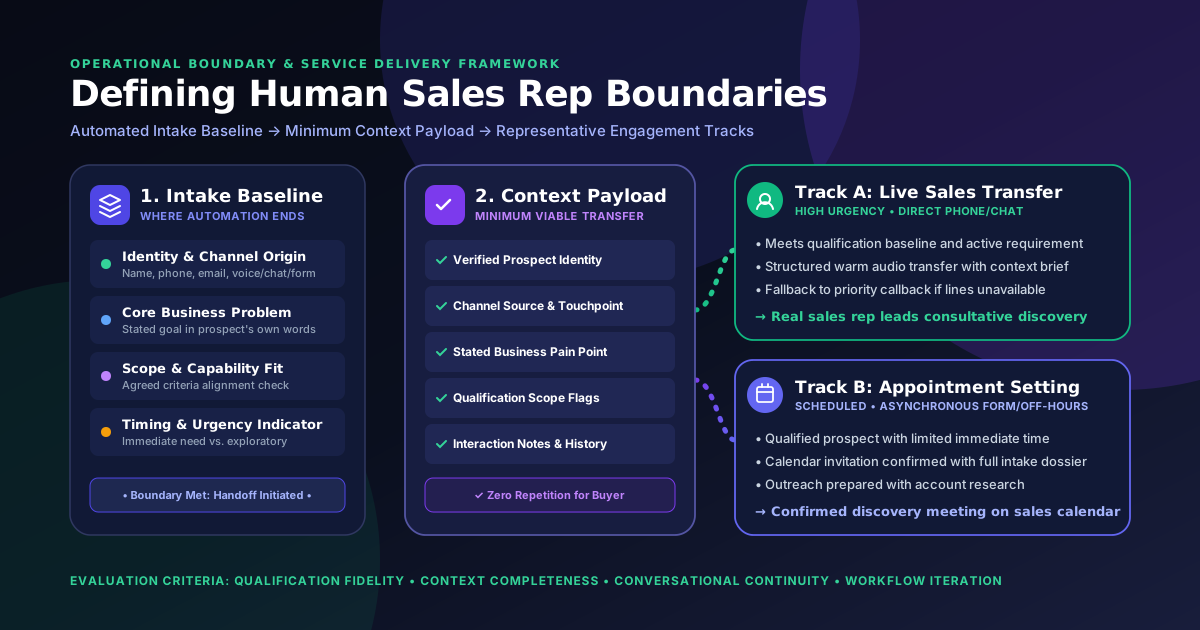
When a B2B sales organization engages an outsourced inbound sales service combining AI speed and real human sales representatives, the most critical operational decision is establishing the exact boundary between automated qualification and human representative involvement.
In an effective hybrid inbound model, automation and human sales professionals do not compete; they perform complementary roles. Automated systems provide immediate responsiveness across inbound phone calls, website chats, and form submissions, gathering essential facts while buyer interest is at its peak. Real human sales representatives bring empathy, domain knowledge, conversational agility, and strategic judgment to build rapport, navigate complex objections, and guide prospective clients toward a booked sale.
However, if the boundary between these two capabilities is poorly defined, the engagement quickly suffers from one of two operational failure modes:
- Premature human handoff: Unfiltered inquiries are transferred to human sales representatives before fundamental qualification facts are established. Highly compensated sales professionals spend their time answering routine directory questions, verifying basic contact details, or speaking with out-of-scope prospects who have no budget or authority.
- Automated over-handling: Automated qualification attempts to execute an entire consultative sales discovery through rigid decision trees. High-intent, qualified buyers become frustrated by repetitive automated prompts, feel treated like support tickets, and abandon the conversation before ever reaching a human sales representative.
To avoid both pitfalls, B2B sales leaders must establish clear operational boundaries: defining precisely where automated qualification ends, where human sales conversations begin, and what objective evaluation criteria govern service delivery.
1. Establishing where automated qualification ends: The intake baseline
Automated qualification should never attempt to close a deal or conduct a complete discovery audit. Its sole operational objective is to gather the intake baseline—the minimum set of structured facts required to determine whether an inquiry warrants human representative involvement and to equip that representative to lead a productive conversation.
In an outsourced inbound sales model, the automated intake baseline should establish four core facts before triggering a human handoff:
- Identity and channel origin: The prospect’s full name, business email, direct phone number, company name, and the specific inbound channel used (inbound phone call, website chat widget, or web form submission).
- Core business problem or stated objective: The primary challenge or initiative prompting the inquiry. Rather than forcing a prospect through an extensive questionnaire, automated intake should capture their self-identified goal in their own words.
- Basic fit and scope alignment: A concise check against agreed qualification criteria—such as company size, geographic service area, or product category—to confirm the inquiry falls within your company’s operational capabilities.
- Timing and urgency indicator: Whether the prospect is experiencing an immediate operational challenge requiring same-day assistance, actively planning an upcoming initiative, or conducting preliminary research.
Once these baseline facts are captured, automated qualification has completed its job. Continuing to probe through automated scripts risks buyer fatigue. At this exact threshold, the workflow must transition the interaction to the human sales layer.
2. Defining where human sales conversations begin: Three involvement models
Human sales representative involvement is not a monolithic step. Depending on the prospect’s channel, urgency, and qualification profile, human engagement should follow one of three distinct involvement models:
[Inbound Inquiry: Phone / Chat / Form]
                   │
                   ▼
       [Automated Qualification]
   (Identity, Problem, Fit, Timing)
                   │
         ┌─────────┴─────────┐
         ▼                   ▼
[Meets Criteria?]       [Unqualified / Out of Scope]
         │                   │
         │                   ▼
         │         [Polite Guidance / Resource]
         │
         ├─────────────────────────────────────────┐
         ▼                                         ▼
[High Urgency / Direct Call]             [Scheduled Preference / Asynchronous]
         │                                         │
         ▼                                         ▼
[Model 1: Live Human Sales Transfer]     [Model 2: Scheduled Appointment Setting]
         │                                         │
         └─────────────┬───────────────────────────┘
                       ▼
         [Model 3: Context-Rich Sales Follow-Up]
         (For asynchronous form inquiries or off-hours)
Involvement Model 1: Live human sales transfer (Immediate conversation)
For inbound phone callers who meet agreed qualification criteria and express immediate purchasing intent, the optimal handoff is a live, warm transfer to an available human sales representative.
- When to trigger: The caller satisfies baseline qualification criteria, has an active project or immediate requirement, and is prepared to discuss solutions immediately.
- Representative responsibility: Acknowledge the context already gathered by the automated intake, confirm the prospect’s primary objective without asking them to repeat themselves, and conduct an initial consultative sales conversation.
- Operational requirement: A structured warm transfer protocol that passes the prospect’s verified details directly to the representative before the audio connection is bridged.
Involvement Model 2: Structured appointment setting
Not every qualified prospect is available for an extended sales conversation at the precise second they reach out. Many inbound inquiries occur while a prospect is between meetings, multitasking, or browsing from a mobile device.
- When to trigger: The prospect is qualified but indicates limited immediate availability, reaches out via website chat, or prefers a dedicated time slot for an in-depth discussion.
- Representative responsibility: The representative (or sales coordinator) coordinates a confirmed calendar appointment directly on the client’s sales team calendar, ensuring the calendar event includes the complete qualification summary.
- Operational requirement: Direct calendar scheduling integration that confirms meeting times, generates invite confirmations, and delivers the intake brief to the assigned account executive.
Involvement Model 3: Context-rich sales follow-up
For asynchronous inbound web forms, detailed off-hours inquiries, or complex technical requests, immediate live conversation may not be possible or appropriate.
- When to trigger: An inquiry arrives through a website form submission, chat message outside standard operating windows, or an inquiry requiring preliminary account research prior to outreach.
- Representative responsibility: A human sales representative reviews the qualification record, prepares account-specific talking points, and conducts personalized sales outreach via direct phone call or tailored email.
- Operational requirement: Immediate notification to the sales representative with full intake context, ensuring follow-up outreach occurs while the prospect’s interest remains warm.
3. Service delivery protocols: Context continuity and exception handling
The success of an outsourced inbound sales team depends on the rigor of its service delivery protocols. Even skilled sales representatives will fail if the underlying handoff process loses context or mishandles exceptions.
Two protocols govern seamless service delivery:
The Minimum Viable Context Payload
A primary source of prospect frustration during outsourced sales engagements is having to repeat information already provided during intake. To preserve conversational momentum, every handoff must carry a Minimum Viable Context Payload directly to the human representative:
| Context Element | Description | Purpose for Human Sales Rep |
|---|---|---|
| Prospect Identity & Organization | Verified contact name, business title, company name, direct email, phone. | Enables immediate, personalized address without re-verifying basic contact fields. |
| Inbound Channel & Touchpoint | Originating phone line, chat page URL, or campaign form source. | Explains what specific marketing message or touchpoint prompted the inquiry. |
| Stated Business Need | Verbatim summary of the prospect’s pain point or requested outcome. | Allows the rep to open the conversation directly addressing the stated problem. |
| Qualification Threshold Flags | Fit confirmations (budget indicator, company size, timeline, authority). | Informs the representative of deal scope and priority before engaging. |
| Interaction History & Notes | Any specific questions asked during automated intake or prior visits. | Prevents repetitive questioning and ensures continuity across touchpoints. |
Exception and Fallback Protocols
Operational boundaries must also define what happens when an interaction deviates from the standard happy path:
- Unanswered live transfer fallback: If a live phone transfer is initiated but no human sales representative is immediately available to bridge into the call, the workflow must smoothly transition to calendar appointment scheduling or record a high-priority callback request. The caller must never be dropped into an unmonitored voicemail or disconnected.
- Out-of-scope inquiries: Inquiries seeking vendor procurement, student research, or services outside the company’s core offering must be politely identified by automated intake and provided appropriate guidance, protecting human sales representatives from administrative distraction.
- Technical or specialized escalation: When an inbound inquiry asks deeply specialized architectural or regulatory questions beyond standard sales qualification, the workflow must capture the specific technical question and route it directly to designated senior specialists.
4. Establishing objective evaluation criteria for service delivery
When evaluating an outsourced inbound sales engagement, sales leaders frequently make the mistake of measuring the wrong metrics. Contracting around arbitrary response-time guarantees (such as “every lead contacted in under 60 seconds”) or rigid staffing ratios often incentivizes rushed, low-quality interactions and artificial handoffs.
Instead, service delivery should be evaluated using four objective operational criteria:
Criterion 1: Qualification fidelity and boundary discipline
- What it measures: Are inbound inquiries correctly sorted at the operational boundary? Are qualified prospects consistently identified and routed to human representatives, while out-of-scope inquiries are appropriately filtered?
- How to evaluate: Conduct regular qualitative audits of handoff records. Review a sample of qualified transfers and disqualified inquiries to verify that agreed qualification criteria were applied accurately.
Criterion 2: Context payload completeness
- What it measures: Does the human sales representative receive all agreed baseline facts prior to engaging the prospect?
- How to evaluate: Audit sales rep briefing notes against initial prospect transcripts. Confirm that contact details, company information, stated pain points, and urgency indicators are consistently captured and communicated.
Criterion 3: Prospect conversational continuity
- What it measures: Does the prospect experience a cohesive, professional transition from automated intake to human sales representative without being asked to repeat information?
- How to evaluate: Review call recordings and prospect feedback to ensure representatives acknowledge earlier responses and build naturally upon the intake context.
Criterion 4: Collaborative workflow iteration
- What it measures: How efficiently does the service adapt as your sales motion evolves? Can qualification prompts, objection guidance, and handoff rules be adjusted quickly based on real-world performance?
- How to evaluate: Track the ease and turnaround time for updating call flows, qualifying questions, and routing paths within the management platform or with service support.
5. Blank illustrative service-delivery and representative-boundary evaluation worksheet
Use this blank planning worksheet to define the exact operational boundaries, handoff rules, and evaluation criteria for your inbound sales engagement before launching service coverage:
====================================================================================================
INBOUND SALES SERVICE-DELIVERY AND REPRESENTATIVE-BOUNDARY EVALUATION WORKSHEET
====================================================================================================

ORGANIZATION: ____________________________________   DATE: ________________________
SALES LEADER / SPONSOR: ___________________________   TARGET LAUNCH DATE: ___________

----------------------------------------------------------------------------------------------------
SECTION 1: INBOUND CHANNEL INTAKE BOUNDARIES
----------------------------------------------------------------------------------------------------
Inbound Channel      Covered?    Automated Intake Role              Boundary Trigger to Human Rep
----------------------------------------------------------------------------------------------------
Inbound Voice Lines  [ ] Yes     Capture name, company, need,       Live transfer if urgent;
                     [ ] No      urgency, and qualification fit.     scheduled calendar if busy.
Website Live Chat    [ ] Yes     Engage visitor, capture email/     Route to appointment calendar
                     [ ] No      phone, qualify interest.           or live chat rep when online.
Inbound Web Forms    [ ] Yes     Acknowledge submission, verify     Context payload to human rep
                     [ ] No      data, qualify key criteria.        for rapid outbound follow-up.
Other Channels       [ ] Yes     ________________________________   _____________________________
                     [ ] No

----------------------------------------------------------------------------------------------------
SECTION 2: AUTOMATED QUALIFICATION BASELINE (WHERE AUTOMATION ENDS)
----------------------------------------------------------------------------------------------------
Intake Dimension     Required Intake Questions / Data Points        Pass / Fail Threshold Criteria
----------------------------------------------------------------------------------------------------
Prospect Identity    • Full Name                                    Valid business email / phone
                     • Company Name / Title                         verified; authorized contact.
Business Need        • Primary problem or service needed            Matches core service offering;
                     • Scope of requirement                         in-scope capability.
Timing & Urgency     • Immediate requirement (< 30 days)            Categorize: Active project vs.
                     • Planning phase / general evaluation          exploratory research.
Authority & Fit      • Company size / budget parameter              Meets minimum deal size or
                     • Decision-making involvement                  target customer profile.

----------------------------------------------------------------------------------------------------
SECTION 3: HUMAN REPRESENTATIVE INVOLVEMENT MODELS (WHERE REPS BEGIN)
----------------------------------------------------------------------------------------------------
Involvement Model    Operational Trigger Condition                  Representative Engagement Scope
----------------------------------------------------------------------------------------------------
Model 1: Live Call   Caller meets qualification baseline and        Warm transfer bridge; rep
Transfer             requests immediate solution discussion.        leads consultative discovery.
Model 2: Calendar    Prospect qualified; prefers scheduled          Rep confirms meeting invite;
Appointment Setting  discussion or reaches chat off-hours.          prepares full intake dossier.
Model 3: Context     Asynchronous web form or message               Rep conducts personalized
Outbound Follow-Up   meeting qualification criteria.                phone/email outreach with context.

----------------------------------------------------------------------------------------------------
SECTION 4: SERVICE-DELIVERY EVALUATION CRITERIA
----------------------------------------------------------------------------------------------------
Evaluation Criterion            Review Cadence        Evaluation Method & Standard
----------------------------------------------------------------------------------------------------
Qualification Fidelity          [ ] Weekly            Audit 10 random handoffs; verify qualification
                                [ ] Monthly           accuracy against agreed rubric (>90% accuracy).
Context Payload Completeness    [ ] Weekly            Check that all 5 baseline data points travel
                                [ ] Monthly           with every transferred lead record.
Handoff Continuity              [ ] Monthly           Review call recordings; ensure rep acknowledges
                                [ ] Quarterly         prior intake context without repeating questions.
Workflow Adaptability           [ ] Ongoing           Verify changes to call flows or qualification
                                                      prompts are executed promptly in-platform.

----------------------------------------------------------------------------------------------------
SECTION 5: EXCEPTION & FALLBACK RULES
----------------------------------------------------------------------------------------------------
Exception Scenario                     Configured Operational Action
----------------------------------------------------------------------------------------------------
Unanswered Live Transfer               Seamlessly offer calendar booking or prioritized callback.
Out-of-Scope / Non-Sales Inquiry       Politely decline or provide self-service directory guidance.
Specialized Technical Question         Capture specific query; route to assigned senior specialist.
====================================================================================================
6. Illustrative scenario: Defining rep boundaries for a B2B logistics firm
To see how operational boundaries function during an active engagement, review this practical planning scenario:
Apex Freight Logistics, a mid-sized B2B third-party logistics (3PL) and freight brokerage firm, generates substantial inbound interest across three channels: direct phone calls to their regional dispatch desk, website chat inquiries from freight brokers, and web quote forms submitted by shippers.
Prior to implementing an AI-plus-human inbound sales service, Apex struggled with lead routing. Inbound calls were routed directly to senior logistics brokers, who spent up to half their working hours fielding low-margin parcel inquiries, checking tracking numbers for existing shipments, or taking messages from vendors. Meanwhile, high-value full-truckload (FTL) shippers who filled out web forms frequently waited hours for follow-up.
To fix this operational bottleneck, Apex’s VP of Sales defined clear representative involvement boundaries:
- Automated Intake Baseline: The service’s automated layer handles immediate intake across voice, chat, and forms. It captures contact details, confirms shipment type (parcel vs. LTL vs. FTL), verifies freight lanes, and checks shipping volume. Existing customer support questions and tracking requests are immediately routed to customer service.
- Live Transfer Boundary (Model 1): If an inbound caller manages recurring commercial freight (minimum 5 truckloads monthly) and requires immediate lane coverage, the automated layer initiates a live warm transfer to Apex’s senior brokerage team, passing the shipper’s lane details and volume requirements directly to the broker’s screen before connecting the audio.
- Appointment Setting Boundary (Model 2): If an inbound web chat prospect qualifies as an enterprise shipper but is inquiring after standard business hours, the system gathers their shipping specifications and schedules a 20-minute discovery consultation on the enterprise sales director’s calendar for the following business morning.
- Context Follow-Up Boundary (Model 3): Inbound web quote submissions are enriched with verified company size and lane data, then routed directly to designated inside sales representatives with complete context dossiers for rapid outbound consultation.
- Service Delivery Evaluation: Apex’s sales leadership conducts a bi-weekly audit of handoff records. Rather than enforcing an arbitrary seconds-to-answer SLA, they evaluate qualification fidelity (did transferred shippers truly meet the 5-truckload threshold?) and context completeness (did the broker know the origin, destination, and volume before saying hello?).
As a result, Apex’s human sales representatives spend their time engaged in high-value commercial sales conversations, while prospective shippers receive fast, structured attention across every touchpoint.
This scenario is a hypothetical, illustrative example designed to demonstrate workflow planning; it does not represent an actual customer endorsement or specific transaction.
7. How Your Sales Team AI supports your inbound sales motion
Your Sales Team AI is built specifically to deliver this hybrid inbound sales model: combining automated speed for immediate first response and intake qualification with real human sales representatives who join the sales conversation and appointment-setting path.
For more detail on our background and related coverage, see our guide on evaluating whether an AI-plus-human service fits your sales motion, our overview of where AI response ends and a human sales rep begins, our breakdown of how qualification prepares the sales conversation, and our approach to connecting context across phone, chat, and form channels.
The four-stage inbound response path
As detailed in our How It Works guide, our service operates across four coordinated stages:
- Respond: Meet the inbound moment across phone calls, chats, and form inquiries with an approved, professional opening.
- Qualify: Gather essential qualification context and understand prospect intent before deciding the next step.
- Involve People: Bring real human sales representatives into the conversation when consultative judgment and relationship building are required.
- Move Forward: Transition qualified buyers seamlessly into a live sales dialogue or confirmed calendar appointment.
For additional details on service structure and common questions, explore our FAQ page or review our core services.
Standard commercial terms and subscription structure
To make inbound phone coverage transparent and accessible, Your Sales Team AI offers straightforward subscription terms governed by our Terms of Service:
- Base Subscription: The standard AI Phone Agent subscription is $249 per month, billed month to month.
- Included Allowances: Each monthly billing period includes 500 inbound minutes and 500 SMS.
- Overage Rates: Usage above monthly allowances is billed transparently at $0.15 per additional minute and $0.03 per additional SMS.
- Zero Setup Fees: There is no setup or onboarding fee ($0 setup fee).
- Assisted Onboarding: To begin, you provide your business details and call handling guidance; a sales agent assists in establishing your initial call flow.
- Flexible In-Platform Updates: Later changes to call flows, qualification questions, and routing rules can be made directly in the platform, with support available for additional assistance.
- Month-to-Month Flexibility: Cancel before the end of the current billing period to prevent renewal for the next cycle. Service remains active through the paid period, and accrued overages remain due. Refunds for prepaid monthly phone service are evaluated case by case.
Clients ready to initiate phone coverage can proceed directly through our secure hosted checkout at Start phone service.
8. Next steps for B2B revenue leaders
Defining the boundaries of human sales representative involvement transforms outsourced inbound lead response from a disconnected operational tool into a core revenue engine.
Before deploying an inbound sales service, revenue leaders should take three practical steps:
- Audit your current inbound touchpoints: Review where inbound interest enters your business today—phone lines, live chat widgets, and contact forms—and identify where qualified prospects encounter friction or delay.
- Complete the boundary evaluation worksheet: Use the worksheet above to define your minimum qualification baseline, trigger conditions for live transfers versus scheduled appointments, and required context fields.
- Map your sales motion with our team: Book a call with Your Sales Team AI to review your inbound channels, refine your qualification questions, and configure the optimal human representative involvement boundaries for your sales organization.